Sunday, 15 September 2013

Felsham in 1674 during the reign of Charles II

The Suffolk Hearth tax returns provides us with a list of some of the people who lived in Felsham in 1674.

"National taxation records are of particular value to historians, providing rare snapshots of both the extent and distribution of wealth and population across an entire country. The Hearth Tax of the 1660s and 1670s provides one such detailed picture of the socio-economic and demographic structure of England and Wales. In addition, the information on hearths sheds invaluable light on vernacular architecture and on developments in building during the later seventeenth century."
http://www.roehampton.ac.uk/Research-Centres/Centre-for-Hearth-Tax-Research/

The Hearth Tax was introduced in England and Wales by the government of Charles II in 1662 at a time of serious fiscal emergency. The original Act of Parliament was revised in 1663 and 1664 and collection continued until the tax was finally repealed by William and Mary in 1689.

Under the terms of the grant, each liable householder was to pay one shilling for each hearth within their property for each collection of the tax. The tax was payable by people whose house was worth more than 20s a year and who contributed to local church and poor rates. Large numbers of people were exempt from paying the tax. Those individuals who were not liable to pay for reasons of poverty were required to obtain a certificate of exemption from the parish clergyman, churchwardens and overseers of the poor, countersigned by two Justices of the Peace. As a result, the hearth tax assessments cannot be considered to provide anything approaching a comprehensive census of the population.

Payments were due twice annually, at Michaelmas (29 September) and Lady Day (25 March), starting at Michaelmas 1662. However, the administration of the tax was extremely complex and assessment and collection methods changed radically over time. As a result, the majority of the surviving documents relate to the periods when the tax was administered directly by royal officials, who returned their records to the Exchequer, namely the periods 1662-1666 and 1669-1674.

Outside these periods, the collection of the tax was ‘farmed out’ to private tax collectors, who paid a fixed sum to the government in return for the privilege of collecting the tax. These farmers were not required to send their assessments into the Exchequer, although a few returns from these periods do survive. (Source: M, Durrant, History of Badley).
FELSHAM HEARTH TAX RETURNS 1674


John Fryar

4

John Motham

4

William Deekes

5

John Groom/Widow Spurgeon

3

John Spurgeon

6

William Scare

4

Mr [Thomas ] Brundish [the Rector 1646-1680]

4

Anthony Hayward

3

James Hayward

4

Thomas Warren

4

Mr Nunn [Also owned a house in Gedding with 4 hearths]

5

Robert South

7

Mr Robert Goodrich

5

Dan. Mount/Richard Kemball

3

John Banham

5

John Hayward

6

John Sterne

5

Charles Sterne

5

George Cockseage

4

Widow Worth/ George Partridge

3

William Grimwood/ Thomas Todd

3

Hezekiah Draper

3

Jos Ranson

3

John Ely

4


Total hearths

99

CERTIFIED for.


Robert Groome/Anthony Groome/John Groome

3

Widow Alexander/Edward Hawkins

3

Augustus Heylder/James Mayhew

2

John Hamont sen. & jun.

2

John Grimwood/William Lockwood

2

Towne houses

3

Exemptions

15
With the number of hearths averaging about 4, the people of Felsham were mostly living in farmhouses and cottages.  There is no large house listed.  The Lord of the Manor in 1674 was John Risby Esq. who lived in Thorpe Morieux in a house with 11 hearths.

To help put these village statistics in some sort of perspective it is worth noting that the house with the largest number of hearths in Suffolk was Hengrave Hall with 55, while more locally we have Rushbrook Hall with 33.

Mr Robert Goodrich is, perhaps, the most interesting person among the list of Felsham  tax payers.  Certainly, we know more about him than some of the others.  To begin with he is buried in the centre of the chancel of St Peter's Church and the flagstone that marks his grave bears his impressive coat of arms:


He died in 1731 at the age of 80 years.  Furthermore, a “Robert Goodrich” was a High Sheriff of Suffolk in 1727 and the Felsham gentleman may have been the same person.
(The High Sheriff is the oldest secular office under the Crown and is appointed annually (in March) by the Crown. He was originally the principal law enforcement officer in the county and presided at the Assizes and other important county meetings.)

Sir John Tilley in his “Notes for a history of Felsham” (1951) mentions that in 1718 Mr. Robert Goodrich, Senior, bestowed upon the Church a silver flagon bearing his arms; its "first appearance”, says the register was on Easter Day. It is still in use and, so the Rector tells me, is German work and very valuable."

The earliest mention of the Goodrich family in Felsham was in 1470 in the Wills of the Archdeaconry of Sudbury.  The record includes the will of "Rose Goddrych of Felsham, widow", dated 2nd August 1470.

For more general information about "hearth taxes" see: http://en.wikipedia.org/wiki/Hearth_tax


Monday, 9 September 2013

The Census Returns for Felsham 1841 to 1911

Microsoft Excel allows you to crunch numbers very quickly and easily.  Using this software or other similar spread-sheet programs, the sorting and counting of large amounts of data from the Census Returns is fairly straightforward and provides us with some interesting facts. 

Filling up the census paper. Punch, 1861 Photograph: British Library Board/The British Library

Take Felsham villagers’ names for example.  Popular Christian names among boys show a remarkable consistency throughout the Victorian and Edwardian periods.  William, George and John are regular favourites followed closely by James, Robert and Thomas.  Frederick and Arthur become more common towards the end of the 19th century and the beginning of the 20th.

Choice of Christian names for girls reveals greater variety than the boys particularly during Edwardian times. The girls’ names show less consistency over the whole period but definite favourites do emerge.  Mary Ann and Mary are the clear winners in the popularity stakes throughout the Victorian period but ‘Mary’ alone remains a clear favourite into the 20th century.   Sarah was very common in 1841 but fades away as the 19th century progresses.  Elizabeth is also very popular along with Eliza, but by the beginning of the 1900s, names such as Annie, Alice, Edith and Ellen are becoming more prevalent.

The top three surnames in Felsham during this period were BREWER, SMITH and TURNER.

There is much important work to be done in analysing local census material to highlight historical trends: changes in age structures, occupations, family size, and school attendance are but a few that come to mind.

If you would like a FREE Excel copy of the Felsham censuses contact the EDITOR
See also: http://felshamhistory.blogspot.co.uk/2015/04/local-history-studies-bibliography.html

Sunday, 8 September 2013

Felsham Village Sign ~ with historical connotations

This is FHF's suggestion for a village sign with historical illustrations


This frame represents the predominance of farmhouses with moats in Felsham going back to the early 14th century.  It also indicates the importance of thatch as a roofing medium in our area.
 
This frame represents the importance of Felsham as a market centre going back to the 13th century and the more recent revival of the Felsham Street Fair with its multiplicity of stalls down The Street.
 
This frame represents the presence of an annual Fair in Felsham going back to the early 13th century and the introduction of a Lamb Fair during the Tudor period.  It also represents the continued importance of animals on the local small-holdings.
 
This frame represents the importance of farming in our village with centuries of horse-powered farm implements and waggons.  The waggon illustrated is representative of a Suffolk waggon drawn by four heavy horses.

CB

Tuesday, 2 July 2013

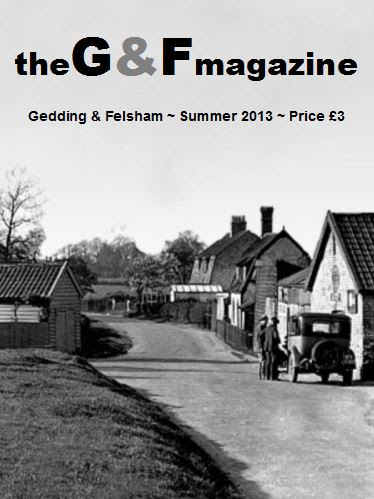
The G&F magazine (the Gedding and Felsham community magazine)

The latest edition of the G&F contains six articles on local history:

  • Felsham Upper Green and Bury Road - past and present
  • The Felsham Shop 1900 to 1940
  • Summer Excursion to Gedding Church 1889
  • The Felsham Lamb Fair
  • The Reading Room
  • The Chamberlains of Gedding Hall


On Sale in Felsham PO Stores.  Price £3


Friday, 24 May 2013

A new account of the life of an important Suffolk Clergyman and Magistrate during the 19th century


Read this exciting new biography of Thomas Anderson who was Rector of Felsham and a Suffolk magistrate for over fifty years.
 

Thomas Anderson

~

Rector of Felsham

1822 to 1872


ON SALE


Felsham PO Stores


Price £6


Also available from the author


The proceeds from the sale of this new booklet will go towards the digitalisation of photographs of Felsham in the Spanton-Jarman Collection. These photographs are held at the Suffolk Record Office on behalf of the Bury Past & Present Society.


Extract from the Foreword to
'Thomas Anderson ~ Rector of Felsham 1822-1872'
 
Any attempt to write the biography of someone who lived over a hundred and forty years ago in Felsham and who left behind no portrait, diary, letters or personal reminiscences is beset with difficulties.  With the Rev. Thomas Anderson there is none of that interesting record left by other 19th century parsons who were his approximate East Anglian contemporaries: Richard Cobbold of Wortham, John Longe of Coddenham, John Henslow of Hitcham, and Benjamin Armstrong of East Derham.
 
We do not know what Thomas Anderson looked like because no drawing, painting or photograph of him has survived.  We do know that he had his photograph taken in Bury St Edmunds sometime during 1864, along with other local clergymen, with prints selling in the photographer’s shop for one shilling each, but it has not been traced.  So a biography without a written or pictorial portrait and without access to documents giving details of character, opinion and social attitudes, could be not only dry and uninteresting but seriously unbalanced. 
 
Nevertheless, it is amazing how much can be re-created from even the most seemingly banal pieces of evidence such as snippets from local newspapers. It must be stressed, though, that this strategy is a minefield for the amateur local historian as deduction based on incomplete evidence can easily turn into fiction and conjecture.   Genealogical sources, mostly on-line, can provide generally accurate access to the basic details of Thomas Anderson’s life – where he was born, when he married, when he died, and so on.  It has been a major task to put some flesh on these rather dry bones of bare fact.  However, we are particularly fortunate in that one of Thomas Anderson’s great nephews lived in Felsham during the 1930s and 40s and related some family anecdotes that give a wonderful glimpse of happenings inside the Rectory during his great uncle’s incumbency.
 
 We are also fortunate in that Thomas Anderson was not only a rector but a magistrate and sometime Chairman of the Suffolk Quarter Sessions, and as such was frequently mentioned in reports of court proceedings in local newspapers such as the Bury & Norwich Post and the Ipswich Journal.  So, although we will probably never know much about his personal life, Thomas Anderson had a public persona as a well-regarded and conscientious magistrate which can give us some clue as to his social attitudes and his position in society.  Nevertheless, the reader may feel that the biography which follows is seriously over-dependent on reports, articles and advertisements in newspapers.  It can only be hoped that, in time, more background information on Thomas Anderson will become available and that a more rounded “life” will eventually emerge.
 
As a well-educated man and ordained priest, Thomas Anderson would certainly have known George Herbert’s book The Country Parson, written one hundred and seventy years before he arrived in Felsham.  In this seminal book he would have read Herbert’s description of the ideal parson’s life which included the stricture:
 
The Countrey Parson is exceeding exact in his Life, being holy, just, prudent, temperate, bold, grave in all his wayes
 
Despite the research constraints outlined above, this brief biography provides plenty of evidence that Thomas Anderson’s life reflected many of these virtues that George Herbert held in such high esteem.

Friday, 3 May 2013

THOMAS ANDERSON – RECTOR OF FELSHAM 1822-1872

Illustrated history talk
 
Tuesday 7 May 2013
8 p.m.
Felsham Village Hall


Cheese and wine
Everyone welcome
Donations to ‘Bury St Edmunds Past & Present Society’

 
Christopher will be talking about his new biography of Thomas Anderson who was Rector of Felsham and a Suffolk magistrate for over fifty years.

The proceeds from the sale of his new book will go towards the digitalisation of photographs of Felsham in the Spanton-Jarman Collection. These photographs are held at the Suffolk Record Office on behalf of the Bury Past & Present Society.

His new book will be on sale at the meeting, price £6.  There will also be a sale of local history books.

Saturday, 6 April 2013

Felsham in 1911

I have just started work analysing the Felsham Census Returns for 1911. Below is just a taster of the sort of analyses that we can carry out on this census in readiness for work on Felsham 1914-18

Birthplaces

1911 (351 living or staying in Felsham on night of census)

93% of villagers in 1911 were born in Suffolk. 7% were born outside the county.

Of those, 43% were born in Felsham.

61% of villagers were born in Felsham or one of the neighbouring villages of Brettenham, Bradfield St George, Cockfield, Gedding, Rattlesden, and Thorpe Morieux.

The map shows the birthplaces in Suffolk of those not born in Felsham itself:


Friday, 18 January 2013

Hard Cheese!

I was interested to read in the EADT (16 January, ‘Make time for a traditional farmhouse breakfast this weekend’) that next week is Farmhouse Breakfast Week.  We are told that breakfast is the most important meal of the day and plays a key role in helping tackle obesity and reducing heart disease and diabetes.

The “traditional breakfast” is often portrayed as the “full English breakfast” – eggs, bacon, mushrooms, etc.  But readers may be interested to know that workers in the Suffolk farmhouses of the mid-nineteenth century were eating something quite different.

During 1894 and 1895, the Suffolk Times and Mercury featured a series of articles entitled  “The autobiography of a Suffolk Farm Labourer: with recollections of incidents and events that have occurred in Suffolk, during the sixty years from 1816 to 1876”.  In his ‘autobiography’, the farm worker recalls his memories of breakfast in the farmhouse kitchen:

“... The meals were taken in the old-fashioned kitchen, which had an open fire-place.  During winter a large block of wood made the room comfortably warm.  Master, mistress, and servants were all in the same room, though not at the same table.  Visitors, who often dropped in sat with the family, but the conversation went on regardless of our presence….

For breakfast we had pork, bread, Suffolk cheese, and a pint of mild beer. 
 
Suffolk cheese has been a subject for much deserved satire.  An unimpeachable authority – Robert Bloomfield – describes a piece of it as

‘Too big to swallow, and too hard to bite.’
 
… I well recollect that the cheese we ate was cut in half by a hand saw; one half was at breakfast time placed on a “footman” with its face to the fire, till it began to “sizzle” and turn brown, then we cut off the cooked slice and ate it with fat pork.”

(NB: A footman is a piece of furniture made of brass or steel, similar in design to footstool, that was commonly used for keeping dishes warm in front of fires.)

Metal footman

Monday, 29 October 2012

Hard Times in Felsham: the life of Robert Kidby 1813-1848


“Hard Times” is Dickens’ powerful description of the grim lives led by factory workers in a Lancashire mill town in the 1840s.  During the same period, life for farm workers in Suffolk could be equally grim and challenging.  Poets may have waxed lyrical about a rural idyll, but in reality, country life was frequently ‘nasty, brutish and short.’  Chronic illness could make you unfit for farm work and force you to become dependent on the 19th century equivalent of social security: charity handouts, parish dole and the dreaded workhouse.


Robert Kidby, a Felsham farm labourer, was dogged by persistent ill-health and weakness all his working life. He died young in 1848 at the age of thirty-five, and was buried in a pauper’s grave in the local churchyard.  During the last few years of his life, he and his family were in receipt of parish relief.  We know this because they appear in the official records of the overseers of the poor.

 
Robert was born in 1813 in a small cottage at Mudlin End and started work on a farm at the age of twelve.  He had regular work to begin with but eventually he ended up being a day labourer – employed only when work was available.

 
In 1840, when he was 27 years old, Robert married Esther Snelling in Felsham Church and soon after a son called Reuben was born.  Then, about a year after their marriage, Robert and his small family moved a few miles to the adjoining parish of Cockfield.

 
In 1845, the family were receiving help from the parish of Cockfield in the form of bread flour and small amounts of cash. Clearly, Robert’s illness prevented him from providing adequately for his family. In the same year, their four-year old son Reuben died.

 
However, a year later, Esther gave birth to a daughter, whom they named Caroline.  The family were still on the bread-line and receiving parish assistance but the time had now arrived for the family to be legally deported to their “village of settlement” which was Felsham.  Soon after his return to his village of birth, Robert is reported as being treated for his illness in the workhouse at Onehouse while his family is recorded as receiving “out-relief” from the Felsham overseers of the poor. 

 
After Robert’s death in 1848, Esther and her two-year old daughter Caroline moved to Bradfield St George.  They were recorded in the Census of 1851 but what happened to them after that we do not know.

(Oct 2012)

****************************************************************************************

A detailed description of the life of Robert Kidby can be found in PART THREE of the illustrated booklet:

FARM LABOURERS AND THEIRFAMILIES IN A SUFFOLK VILLAGE ~ FELSHAM1830-50
 
Available from Felsham Post Office priced £3.50


****************************************************************************************

Friday, 15 June 2012

Where was Felsham’s Baptist Chapel?

During the19th century, non-conformists had a considerable presence in Felsham. Wesleyans, Primitive Methodists, and Congregationalists all had official meeting houses though we know little about the size of their congregations. The exception is to be found among the Baptists. It is recorded in the Religious Census of 1851 that they had a Chapel in Felsham which adjoined a dwelling house, and that on Sunday 30th March (the date when the census was taken), a hundred people attended the evening service.

The Religious Census also records that 248 people attended the evening service in the Parish Church of St Peter’s. The population of Felsham at this time was about 400. If the congregations of the Baptist Chapel and the Parish Church were all drawn from within the village, the figures suggest that over half the population attended the established church and that a quarter of the population were dissenters.

If these figures are accurate it is quite remarkable that the religious practices of such a large proportion of the population in Felsham in the mid-19th century have received so little attention. The reason must be to do with the relative dearth of information.  The parish records are fairly comprehensive in providing information about the Parish Church but are absolutely silent with reference to non-conformist or dissenting places of worship.

The mention of a Felsham Baptist Chapel in the religious census leaves us with a number of questions:
  • Where was this chapel situated in the village?
  • What did the building look like?
  • Who were the 100 people that attended the evening service?
  • When did the chapel fall into disuse?

Some answers are to be provided in the Minute Book of meetings of the Rattlesden Baptist Church. In 1851, both Felsham and Rattlesden shared the same Baptist Minister and it is clear that the Felsham Chapel was a “daughter” chapel to that at Rattlesden. A clue to where the Felsham Chapel was situated is provided in a Minute of a meeting held on 16th July 1850:

‘Mr Gladwell of Felsham having made an offer of a room in his house for occasional preaching on condition of paying him 5/- to have it whitewashed etc. and afterwards an annual collection of about 10/- and to defray the expense of lighting and cleaning. We agreed to accept the offer.”


It is highly probable that this is the same house that was recorded as a Baptist Chapel during the 1851 Religious Census that took place about eight months later.

It is also likely that the Mr Gladwell mentioned was Mr Joseph Gladwell, a master shoemaker, who was living and working in a house on the south side of The Street between the Church and the Rectory. The Minute Book mentions ‘a room’ which would have hardly been large enough to house the 100 people mentioned in the religious census. However, maps show that the house was surrounded by many outbuildings and barns. It is probable that it was one of these buildings which housed the hundred members of the Baptist congregation that attended evening service on that Sunday in 1851.

Joseph Gladwell’s house with its attached ‘Baptist Chapel’ no longer exists. It was demolished sometime between 1851 and 1895 when the 1st edition of the OS map for Felsham shows that the whole area between the Poorhouse [the current PO Stores] and the Rectory gardens had reverted to fields.

In 1897, a new school was built on the site of Joseph Gladwell’s house and is now the Village Hall.

A fully referenced article on the Felsham Baptists, with illustrations and maps, is available online at http://felshamhc.onesuffolk.net/articles/