Tuesday, 2 July 2013

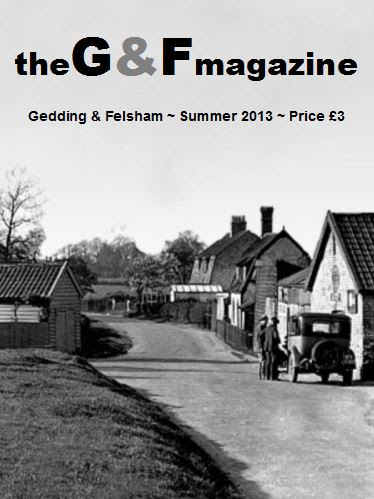
The G&F magazine (the Gedding and Felsham community magazine)

The latest edition of the G&F contains six articles on local history:

  • Felsham Upper Green and Bury Road - past and present
  • The Felsham Shop 1900 to 1940
  • Summer Excursion to Gedding Church 1889
  • The Felsham Lamb Fair
  • The Reading Room
  • The Chamberlains of Gedding Hall


On Sale in Felsham PO Stores.  Price £3


Friday, 24 May 2013

A new account of the life of an important Suffolk Clergyman and Magistrate during the 19th century


Read this exciting new biography of Thomas Anderson who was Rector of Felsham and a Suffolk magistrate for over fifty years.
 

Thomas Anderson

~

Rector of Felsham

1822 to 1872


ON SALE


Felsham PO Stores


Price £6


Also available from the author


The proceeds from the sale of this new booklet will go towards the digitalisation of photographs of Felsham in the Spanton-Jarman Collection. These photographs are held at the Suffolk Record Office on behalf of the Bury Past & Present Society.


Extract from the Foreword to
'Thomas Anderson ~ Rector of Felsham 1822-1872'
 
Any attempt to write the biography of someone who lived over a hundred and forty years ago in Felsham and who left behind no portrait, diary, letters or personal reminiscences is beset with difficulties.  With the Rev. Thomas Anderson there is none of that interesting record left by other 19th century parsons who were his approximate East Anglian contemporaries: Richard Cobbold of Wortham, John Longe of Coddenham, John Henslow of Hitcham, and Benjamin Armstrong of East Derham.
 
We do not know what Thomas Anderson looked like because no drawing, painting or photograph of him has survived.  We do know that he had his photograph taken in Bury St Edmunds sometime during 1864, along with other local clergymen, with prints selling in the photographer’s shop for one shilling each, but it has not been traced.  So a biography without a written or pictorial portrait and without access to documents giving details of character, opinion and social attitudes, could be not only dry and uninteresting but seriously unbalanced. 
 
Nevertheless, it is amazing how much can be re-created from even the most seemingly banal pieces of evidence such as snippets from local newspapers. It must be stressed, though, that this strategy is a minefield for the amateur local historian as deduction based on incomplete evidence can easily turn into fiction and conjecture.   Genealogical sources, mostly on-line, can provide generally accurate access to the basic details of Thomas Anderson’s life – where he was born, when he married, when he died, and so on.  It has been a major task to put some flesh on these rather dry bones of bare fact.  However, we are particularly fortunate in that one of Thomas Anderson’s great nephews lived in Felsham during the 1930s and 40s and related some family anecdotes that give a wonderful glimpse of happenings inside the Rectory during his great uncle’s incumbency.
 
 We are also fortunate in that Thomas Anderson was not only a rector but a magistrate and sometime Chairman of the Suffolk Quarter Sessions, and as such was frequently mentioned in reports of court proceedings in local newspapers such as the Bury & Norwich Post and the Ipswich Journal.  So, although we will probably never know much about his personal life, Thomas Anderson had a public persona as a well-regarded and conscientious magistrate which can give us some clue as to his social attitudes and his position in society.  Nevertheless, the reader may feel that the biography which follows is seriously over-dependent on reports, articles and advertisements in newspapers.  It can only be hoped that, in time, more background information on Thomas Anderson will become available and that a more rounded “life” will eventually emerge.
 
As a well-educated man and ordained priest, Thomas Anderson would certainly have known George Herbert’s book The Country Parson, written one hundred and seventy years before he arrived in Felsham.  In this seminal book he would have read Herbert’s description of the ideal parson’s life which included the stricture:
 
The Countrey Parson is exceeding exact in his Life, being holy, just, prudent, temperate, bold, grave in all his wayes
 
Despite the research constraints outlined above, this brief biography provides plenty of evidence that Thomas Anderson’s life reflected many of these virtues that George Herbert held in such high esteem.

Friday, 3 May 2013

THOMAS ANDERSON – RECTOR OF FELSHAM 1822-1872

Illustrated history talk
 
Tuesday 7 May 2013
8 p.m.
Felsham Village Hall


Cheese and wine
Everyone welcome
Donations to ‘Bury St Edmunds Past & Present Society’

 
Christopher will be talking about his new biography of Thomas Anderson who was Rector of Felsham and a Suffolk magistrate for over fifty years.

The proceeds from the sale of his new book will go towards the digitalisation of photographs of Felsham in the Spanton-Jarman Collection. These photographs are held at the Suffolk Record Office on behalf of the Bury Past & Present Society.

His new book will be on sale at the meeting, price £6.  There will also be a sale of local history books.

Saturday, 6 April 2013

Felsham in 1911

I have just started work analysing the Felsham Census Returns for 1911. Below is just a taster of the sort of analyses that we can carry out on this census in readiness for work on Felsham 1914-18

Birthplaces

1911 (351 living or staying in Felsham on night of census)

93% of villagers in 1911 were born in Suffolk. 7% were born outside the county.

Of those, 43% were born in Felsham.

61% of villagers were born in Felsham or one of the neighbouring villages of Brettenham, Bradfield St George, Cockfield, Gedding, Rattlesden, and Thorpe Morieux.

The map shows the birthplaces in Suffolk of those not born in Felsham itself:


Friday, 18 January 2013

Hard Cheese!

I was interested to read in the EADT (16 January, ‘Make time for a traditional farmhouse breakfast this weekend’) that next week is Farmhouse Breakfast Week.  We are told that breakfast is the most important meal of the day and plays a key role in helping tackle obesity and reducing heart disease and diabetes.

The “traditional breakfast” is often portrayed as the “full English breakfast” – eggs, bacon, mushrooms, etc.  But readers may be interested to know that workers in the Suffolk farmhouses of the mid-nineteenth century were eating something quite different.

During 1894 and 1895, the Suffolk Times and Mercury featured a series of articles entitled  “The autobiography of a Suffolk Farm Labourer: with recollections of incidents and events that have occurred in Suffolk, during the sixty years from 1816 to 1876”.  In his ‘autobiography’, the farm worker recalls his memories of breakfast in the farmhouse kitchen:

“... The meals were taken in the old-fashioned kitchen, which had an open fire-place.  During winter a large block of wood made the room comfortably warm.  Master, mistress, and servants were all in the same room, though not at the same table.  Visitors, who often dropped in sat with the family, but the conversation went on regardless of our presence….

For breakfast we had pork, bread, Suffolk cheese, and a pint of mild beer. 
 
Suffolk cheese has been a subject for much deserved satire.  An unimpeachable authority – Robert Bloomfield – describes a piece of it as

‘Too big to swallow, and too hard to bite.’
 
… I well recollect that the cheese we ate was cut in half by a hand saw; one half was at breakfast time placed on a “footman” with its face to the fire, till it began to “sizzle” and turn brown, then we cut off the cooked slice and ate it with fat pork.”

(NB: A footman is a piece of furniture made of brass or steel, similar in design to footstool, that was commonly used for keeping dishes warm in front of fires.)

Metal footman

Monday, 29 October 2012

Hard Times in Felsham: the life of Robert Kidby 1813-1848


“Hard Times” is Dickens’ powerful description of the grim lives led by factory workers in a Lancashire mill town in the 1840s.  During the same period, life for farm workers in Suffolk could be equally grim and challenging.  Poets may have waxed lyrical about a rural idyll, but in reality, country life was frequently ‘nasty, brutish and short.’  Chronic illness could make you unfit for farm work and force you to become dependent on the 19th century equivalent of social security: charity handouts, parish dole and the dreaded workhouse.


Robert Kidby, a Felsham farm labourer, was dogged by persistent ill-health and weakness all his working life. He died young in 1848 at the age of thirty-five, and was buried in a pauper’s grave in the local churchyard.  During the last few years of his life, he and his family were in receipt of parish relief.  We know this because they appear in the official records of the overseers of the poor.

 
Robert was born in 1813 in a small cottage at Mudlin End and started work on a farm at the age of twelve.  He had regular work to begin with but eventually he ended up being a day labourer – employed only when work was available.

 
In 1840, when he was 27 years old, Robert married Esther Snelling in Felsham Church and soon after a son called Reuben was born.  Then, about a year after their marriage, Robert and his small family moved a few miles to the adjoining parish of Cockfield.

 
In 1845, the family were receiving help from the parish of Cockfield in the form of bread flour and small amounts of cash. Clearly, Robert’s illness prevented him from providing adequately for his family. In the same year, their four-year old son Reuben died.

 
However, a year later, Esther gave birth to a daughter, whom they named Caroline.  The family were still on the bread-line and receiving parish assistance but the time had now arrived for the family to be legally deported to their “village of settlement” which was Felsham.  Soon after his return to his village of birth, Robert is reported as being treated for his illness in the workhouse at Onehouse while his family is recorded as receiving “out-relief” from the Felsham overseers of the poor. 

 
After Robert’s death in 1848, Esther and her two-year old daughter Caroline moved to Bradfield St George.  They were recorded in the Census of 1851 but what happened to them after that we do not know.

(Oct 2012)

****************************************************************************************

A detailed description of the life of Robert Kidby can be found in PART THREE of the illustrated booklet:

FARM LABOURERS AND THEIRFAMILIES IN A SUFFOLK VILLAGE ~ FELSHAM1830-50
 
Available from Felsham Post Office priced £3.50


****************************************************************************************

Friday, 15 June 2012

Where was Felsham’s Baptist Chapel?

During the19th century, non-conformists had a considerable presence in Felsham. Wesleyans, Primitive Methodists, and Congregationalists all had official meeting houses though we know little about the size of their congregations. The exception is to be found among the Baptists. It is recorded in the Religious Census of 1851 that they had a Chapel in Felsham which adjoined a dwelling house, and that on Sunday 30th March (the date when the census was taken), a hundred people attended the evening service.

The Religious Census also records that 248 people attended the evening service in the Parish Church of St Peter’s. The population of Felsham at this time was about 400. If the congregations of the Baptist Chapel and the Parish Church were all drawn from within the village, the figures suggest that over half the population attended the established church and that a quarter of the population were dissenters.

If these figures are accurate it is quite remarkable that the religious practices of such a large proportion of the population in Felsham in the mid-19th century have received so little attention. The reason must be to do with the relative dearth of information.  The parish records are fairly comprehensive in providing information about the Parish Church but are absolutely silent with reference to non-conformist or dissenting places of worship.

The mention of a Felsham Baptist Chapel in the religious census leaves us with a number of questions:
  • Where was this chapel situated in the village?
  • What did the building look like?
  • Who were the 100 people that attended the evening service?
  • When did the chapel fall into disuse?

Some answers are to be provided in the Minute Book of meetings of the Rattlesden Baptist Church. In 1851, both Felsham and Rattlesden shared the same Baptist Minister and it is clear that the Felsham Chapel was a “daughter” chapel to that at Rattlesden. A clue to where the Felsham Chapel was situated is provided in a Minute of a meeting held on 16th July 1850:

‘Mr Gladwell of Felsham having made an offer of a room in his house for occasional preaching on condition of paying him 5/- to have it whitewashed etc. and afterwards an annual collection of about 10/- and to defray the expense of lighting and cleaning. We agreed to accept the offer.”


It is highly probable that this is the same house that was recorded as a Baptist Chapel during the 1851 Religious Census that took place about eight months later.

It is also likely that the Mr Gladwell mentioned was Mr Joseph Gladwell, a master shoemaker, who was living and working in a house on the south side of The Street between the Church and the Rectory. The Minute Book mentions ‘a room’ which would have hardly been large enough to house the 100 people mentioned in the religious census. However, maps show that the house was surrounded by many outbuildings and barns. It is probable that it was one of these buildings which housed the hundred members of the Baptist congregation that attended evening service on that Sunday in 1851.

Joseph Gladwell’s house with its attached ‘Baptist Chapel’ no longer exists. It was demolished sometime between 1851 and 1895 when the 1st edition of the OS map for Felsham shows that the whole area between the Poorhouse [the current PO Stores] and the Rectory gardens had reverted to fields.

In 1897, a new school was built on the site of Joseph Gladwell’s house and is now the Village Hall.

A fully referenced article on the Felsham Baptists, with illustrations and maps, is available online at http://felshamhc.onesuffolk.net/articles/

Saturday, 14 April 2012

Hodskinson’s map of Suffolk

"Joseph Hodskinson’s map of Suffolk, published in 1783, was one of a large series of English County maps produced in the second half of the 18th century by entrepreneurial surveyors, engravers and cartographic publishers.

Printed usually at a scale of one inch to the mile, these maps were often the first serious attempt to record English topographical detail, using improved surveying techniques and instruments. Many of the maps are historically important in that they were surveyed just before Parliamentary Enclosure irrevocably changed the rural landscape. Hodskinson’s Suffolk map is particularly unusual in that it was awarded a coveted gold medal by what came to be known as the Royal Society of Arts."

In 2010 Andrew Macnair produced a digitally enhanced version of the original map:

Macnair version of Hodskinson’s map of Suffolk: extract centred on Felsham
I have used part of this digitally enhanced map, which covers Felsham and environs, on the cover of my booklet:

Farm labourers and their families in a Suffolk village
 ~ FELSHAM 1830-50 ~


I chose this 1793 map for the booklet cover because it highlights features that would have been very familiar to the farm labourers living in Felsham in the first half of the 19th century. The three farm labourers who get most mention in the booklet - William Osborn, Robert Kidby and Batley Seaman - would have been growing up during the 20s and 30s, and the road patterns, woodland, place names and commons and greens would have been very familiar to them. In many ways the map provides an impression of Felsham and the adjoining villages that was largely medieval in origin. During the life time of these three farm labourers this traditional pattern would have changed radically as the nineteenth century progressed with greater industrialization, accelerated population growth, and improved communications represented in particular by the arrival of the railway in Suffolk in 1846.

However, this is not to say that the map is a perfect representation of the landscape at the end of the 18th century. Although the Hodskinson map was a considerable improvement on previous maps it contains many anomalies and obvious misrepresentations. The reader familiar with Felsham will be struck by the blob of woodland shown on the map just south of the village centre. This is completely inaccurate. In fact, Hodskinson's biggest failure is his inability to show woodland shape very effectively and his seemingly rather casual attitude to positioning woodland is a serious fault in his approach.

The rather indistinct blob that perhaps is meant to represent Felsham wood on the southern boundary of the parish should, in fact be connected to Thorpe Wood, and should be positioned much further south. The First Edition of the OS Map (surveyed between 1820 and 1860) for the area is far more accurate in this respect:


David Dymond has provided an excellent introduction and overview of Hodskinson's map of Suffolk [See http://www.booksatlarkspress.co.uk/] where he discusses the value of the map to the historian. He points out that one of the strengths of the map is the way it shows the "tight, intricate road-pattern of Suffolk" that is typical of the county. He also points out that "many hedged lanes on the map have now entirely disappeared, or simply survive as rights of way across featureless ploughland." An example in Felsham is the road that begins at Oxes Green on the boundary with Brettenham and heads off towards Hightown Green in Rattlesden. The early OS Map shows an even more complex structure of lanes and paths in this area. The place name "Oxes Green" is something that appears to have disappeared completely from local usage. This emphasizes another important feature of the map: its value as a record of place names many of which have changed or become extinct.

David Dymond explains that the county was surveyed using a triangulation framework. Felsham lies within a triangle where the nodes are the church towers of Elmswell, Brettenham and Bradfield St George. Presumably, all these churches were visible from each other. Dymond points out that:
"In a comparatively gentle landscape like Suffolk's, and given clear atmospheric conditions, it is astonishing how far one can often see from towers 50 to 100 feet high."
The broken line that runs across the Felsham extract of the map, shown above, is Hodskinson's unsuccessful attempt to show the hundred boundary between Stow and Cosford and therefore between Felsham and Cockfield/Brettenham. Dymond decisively rejects the reliability of these boundary lines.
The greens, that are a feature of Felsham village centre, and the general pattern of settlement, including the houses at Mudlin End, are shown quite well on the map. Similarly, the main houses, such as the Rectory, Mausoleum House, and Felsham Hall are represented fairly accurately but there are obvious discrepancies. Where are Brook Hall and Maiden Hall, settlements that go back to medieval times? The Brook Hall omission could be explained by Dymond's comment: "Bearing in mind how eighteenth century surveyors relied on road-traverses, it is perhaps not surprising that a high number of isolated farms have been omitted."  There are other serious omissions, including Moore's farm and Poplar farm, as these farmsteads are called today.

The Rattlesden River and it contributing streams are fairly accurately represented. Relief is delineated on the original Hodskinson map as delicate shading and is particularly relevant to the way they emphasize valleys.


Dymond comments: "The darker end of the shading represents the higher end of the slope, as if the sun were falling on the uplands and casting deep shadows on the slopes."

Perhaps, the most striking feature of this 1793 map is how little common land there was in Felsham at this time. Apart from the small twin triangular greens at the village centre, there is a complete absence of the extensive greens to be found in villages like Drinkstone and Hessett.

Dymond comments:
"This map is the best record the economic historian has of the distribution of ancient common land in the county. Although much arable and meadow, particularly in High Suffolk, had been enclosed centuries before, and although local people had been converting bits of common land into private property since at least the thirteenth century, there was still a substantial acreage of greens, commons and heaths for Hodskinson to record in 1783."

The extensive common land at Drinkstone Green was eventually enclosed in the 1840s. The boundary of the old Green can still be traced by following the line of the older houses that surrounded the green. Many of the greens appear to stretch quite long distances along the edges of the highways. The map hints that the Great Green (or Broad Green) at Cockfield extended tentacle-like right up to the area occupied today by Capel Farm and Stone Farm at the western end of the parish of Felsham.

The farm labourers portrayed in my booklet would almost certainly have been aware of the sentiments of the working man towards the enclosure of land, even if, by the mid-nineteenth century it was beginning to fade into folk-lore. Perhaps the most famous out-pouring of feeling on this subject is represented by the Suffolk poet - Nathaniel Bloomfield - who wrote the "Elegy on the Enclosure of Honington Green". I print two verses from this elegy below:

Those fenc'd ways that so even are made,

The pedestrian traveller bemoans;

He no more the green carpet may tread,

But plod on, 'midst the gravel and stones:

And if he would rest with his load,

No green hillock presents him a seat,

But long, hard, tiresome sameness of road

Fatigues both the eye and the feet.


Sighs speak the poor Labourers' pain,

While the new mounds and fences they rear,

Intersecting their dear native plain,

To divide to each rich Man his share;

It cannot but grieve them to see,

Where so freely they rambled before,

What a bare narrow track is left free

To the foot of the unportion'd Poor.


Friday, 13 April 2012

New history booklet on Felsham in the early Victorian period

FARM LABOURERS AND THEIR FAMILIES IN A SUFFOLK VILLAGE
 ~
FELSHAM 1830-50


Christopher Bornett


This exciting new local history booklet from WalkingKit Publications explores the lives of Felsham farm labouring families in early Victorian times.


It is now available from the FELSHAM POST OFFICE STORES.  Price £3.50.
It is also available from the author for £4.50 [incl p&p].  To order click here.


Summary of content:


Farm labourers formed the largest occupational group in Felsham during the 19th century but they were never listed in the official directories of the time. This is fairly typical as the lives of the lowest strata of society, throughout history, are rarely recorded. The local historian who attempts to study the lives of early 19th century agricultural workers is severely hampered by the paucity of biographical material and has to rely fairly heavily on official records such as Census Returns and Parish records, including registers of births, deaths and marriages, as well as accounts kept by the overseers of the poor.

Nevertheless, great effort has been made to re-construct early Victorian village life as seen through the eyes of farm labourers and their wives and children – despite the fact that most of the time they just appear as statistics and names in rather dry and impersonal official documents.

~

Part One of the booklet addresses three questions. Who were the Felsham farm labourers? Where did they live? What did they look like? The focus is on 1838 and 1841 because these were the years in which the Felsham Tithe Map was drawn up and when a Census was taken. Information from Map and Census provides clues about people and places that enable us to build up a picture of village life at this time. To supplement these relatively well documented years of 1838 and 1841, evidence has been gathered from the ten years either side of 1840 to provide sufficient documentation to construct a snapshot of life over twenty years – a generation– to arrive at our chosen period of study: 1830-50. At the beginning of this period, parts of Suffolk witnessed the rural disturbances associated with the Swing riots when hayricks were burnt and machines smashed. The 1830s also witnessed decisive developments in the way the Poor Law was administered. The 1840s saw a revolution in communications with the introduction of the Penny Post at the beginning of the decade and then the arrival of the railway in Suffolk linking Bury St Edmunds, Stowmarket and Ipswich with London, during the second half of the decade.


Part TWO looks at the working life of the farm labourer, his wife, and his children. We explore questions of schooling, diet and the importance of allotments. We focus on one particular family – the Osborn family. This family was one of many in Felsham which rented an allotment provided through the local Charity. The renting of land within the village gave the labourer an important stake in society, raising his self-esteem, as well as providing essential food supplies. We focus on the paternalism of the Charity Trustees and the moral dimension of allotment rules.


In Part THREE the impact of the Poor Laws on the lives of the labourers is examined. This time we focus on a Felsham family – the Robert Kidby family – who fell on hard times and became paupers. This family certainly lived on the “bread line”, receiving help from the parish and experiencing extended periods of unemployment and illness. They spent some time in the village poorhouse and also the Union workhouse near Stowmarket. An attempt will be made to unravel the circumstances in 1846 which led to the family being removed from the neighbouring village of Cockfield and being returned to their “settlement” village of Felsham.


Part FOUR focuses on the issue of migration. Throughout the 19th century a growing number of Suffolk farm labourers were leaving their villages and heading for London or the newly industrialised towns of the north of England. Some departed these shores altogether and emigrated to Canada, Australia or New Zealand. We have documentary evidence of at least one Felsham family which emigrated to South Australia in 1849: the Seaman family. Why did this large family with nine children under the age of fifteen, leave Felsham and undertake a long and arduous sea voyage across the world to set up a new life in the Antipodes? How did they cope with the vicissitudes of life in “steerage class” on a sailing ship in the mid 19thcentury? What happened to the family after they walked down the ship’s gangplank to set up a new life in the young colony of Southern Australia?

~

The text is well supported throughout by maps, charts and illustrations.


Saturday, 28 January 2012

Felsham Paupers in the 1840s

I am currently writing a chapter on the lives of Felsham farm labourers in early Victorian times, entitled "Felsham Paupers in the 1840s".  I was amazed to see this editorial in a contemporary newspaper that discussed issues that were at the forefront of people's minds over a 160 years ago.

I have reproduced the article in full, highlighting the "history lesson" bit in red.

"Rich and poor: deserving and undeserving

The attempt to distinguish between different categories of the poor is almost as old as the modern British state

http://www.guardian.co.uk/commentisfree/2012/jan/27/rich-poor-deserving-undeserving

When the Archbishop of Canterbury warned against "a quiet resurgence of the seductive language of 'deserving' and 'undeserving' poor" he may not have expected his immediate predecessor to lead a charge against "hand-outs given to the long-term unemployed", as he did this week. Yet Lord Carey's attack upon his fellow bishops for resisting the government's welfare reform legislation breathes new life into that most unhelpful of distinctions. According to Lord Carey, we now have a "bloated" welfare system that "rewards fecklessness and irresponsibility". In contrast, the former archbishop offers his own story of how hard work and diligence led him from a Dagenham council estate to Lambeth Palace. By so doing he reinforces the view that there are a whole category of people who are responsible – and thus to be blamed – for their own misfortune.
The attempt to distinguish between different categories of the poor is almost as old as the modern British state. The Elizabethan poor laws were designed to keep the poor at home – and thus to stop them from becoming vagrants. By the time of the Napoleonic wars, however, the rise in population, the escalating cost of war, and sharp differences in the scale of poor relief between urban and rural parishes, all led to the conclusion that the old poor law wasn't working. Utilitarians insisted that a great deal of poverty was not inevitable but a product of fecklessness. Economists like Rev Thomas Malthus argued that the Elizabethan poor law encouraged irresponsibly large families. All this has a horribly familiar ring again today.
The result was the introduction of an increasingly uniform system based around the idea of the workhouse – a place where paupers would be incarcerated and made to work. In 1834 the new poor law was promulgated. At its heart was the notion of less eligibility: reducing the number of people entitled to support, so that only those who could not work (rather than those who would not work) would receive support. It's here that the distinction between the deserving and undeserving poor became a legal one. To deter those who would not work from applying for poor law support, workhouses were made deliberately unpleasant, often resembling a prison as much as a refuge. Critics condemned them as "the new Bastilles". As we celebrate the 200th anniversary of Charles Dickens, we are witnessing a return of just the sort of language about the poor that he did so much to expose as cruel and inhuman.
Who are today's new undeserving poor? The familiar tabloid assumption is that you know them when you see them. The undeserving poor drink White Lightning in the daytime, have too many children, keep dangerous dogs and spend their lives lolling about on the sofa. Now as in the past, the undeserving poor make an easy and popular target, especially when public money is tight again. Which is why references to fecklessness and irresponsibility have become such effective drivers of the coalition's welfare reform legislation.
During the last recession in the 1990s, public attitudes towards those living on benefits were considerably more sympathetic than they are today. Anxieties involving welfare and work, immigration and housing shortage, have all contributed to a hardening approach. As the latest British Social Attitudes survey demonstrates, 55% of the English subscribe to the view that high benefits encourage poor people to remain poor. Which is undoubtedly why even the Labour party is hesitant to challenge the prevailing mood to limit state support for some of the most vulnerable in our society. Like any other government programme, welfare must be open to serious reform. Yet a society that cannot cap the income of the undeserving rich – witness the latest row over bank bonuses this week – but is quite happy to cut off funds to the poor is a society that has learned nothing from its own history."